
Visual Clarity vs. Visual Quality – an important distinction, and why they both have their place
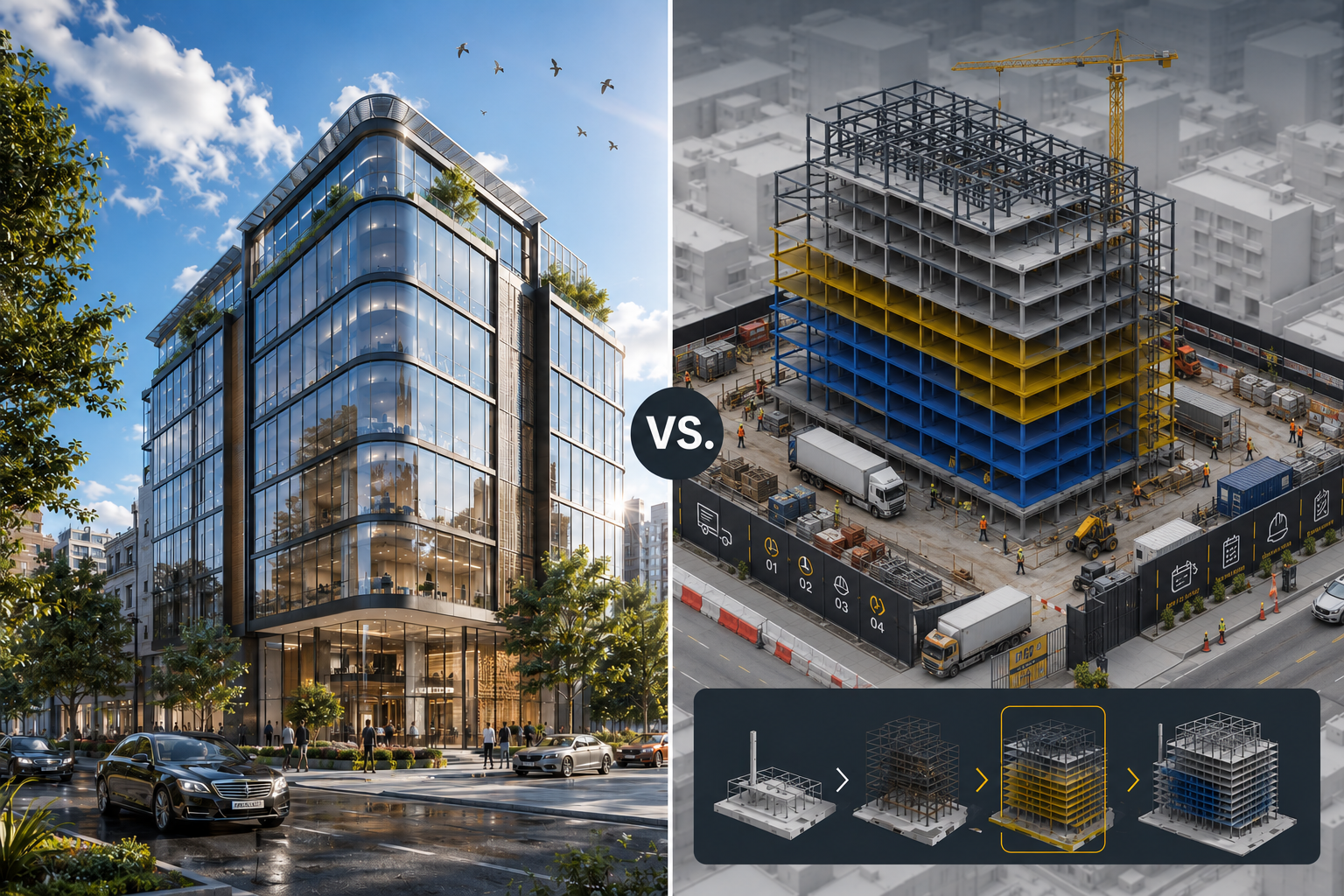
For years within the 4D planning space, the debate has continued about how much value we should place on the visual quality of our outputs. By quality, I'm referring to the polish: correct textures, vehicle movements, foliage, context buildings, the works. We work in an industry that, in the early stages of project development, is awash with CGI imagery designed to sell the vision. Birds in the sky, wind in the trees, a lovely low-light refraction across the glazing as the sun sets. It looks incredible, and with the emergence of AI tools, visuals like these are becoming easier to produce at a lower cost than ever before.
But those images are designed for a specific purpose. To sell the dream. They're rarely an exact match to reality on completion, and they're ultimately a handful of static frames, often based on conceptual design with a degree of artistic licence applied. A single moment in time, beautifully rendered.
Now contrast that with the 4D planning process. If you're lucky, you're starting in the work-winning phase, and what follows is typically a four-to-six-week scramble to understand the design, the site, its constraints, and develop a logistics strategy and programme that hits an impossible week count. The shape of that process tends to look something like this:
Setting the brief. Typically, a two-minute animation, weekly time-slice images, and specific imagery to support methodology documentation around key logistical arrangements and interfaces is the ask.
Week 1. There are always gaps in the information you're working with. Somehow all those birds, trees and context buildings from the CGIs have gone missing. You're filling in those gaps whilst keeping pace with a bid team developing all aspects of the response.
Week 2. You've got a first draft programme. You're now associating the two key datasets, programme and geometry, to get a baseline back to the team for initial review.
Week 3. Reviews draw out the real value of doing 4D well at this stage. The access strategy doesn't quite work whilst you're in the ground, the frame contractor has proposed a different approach, there are now three hoists instead of two.
Week 4. You're updating the model to reflect everything discussed. A revised programme arrives with new WBS detail. Slab pours have shifted, which adjusts the edge protection and formwork modelling. The team start asking for draft outputs for placeholders in presentations and documentation. It's a scramble.
Week 5. Adjudication week. Loose ends are being tied, updated visuals are circulating for review, and final tweaks are landing right up to the wire.
Week 6. Everything is agreed and signed off. Programme development has paused. You're last in line for any final changes.
At the end of this process you've done your best to keep pace, picking up as much detail as possible and ensuring the programme is properly represented. You've built a tool that has actively steered the team through the work-winning period. It has answered dozens of questions, changed the construction approach, and given everyone a stronger basis for the proposal.
And then comes the comment: "It looks great. We can make it look like those CGIs now, right?"
Here's the reality. A typical set of CGI renders for a construction project takes anywhere from three days to several months. For a set of static frames. So why, having built something of genuine strategic value, are we asked to make 3000 frames (2min animation @ 25fps) look CGI quality in 24-48 hours? The model has already served its purpose, and the expectation that every 4D model should look like a CGI render is quietly killing that value. Sure, I can get much closer to photorealism, but that methodology review in week 3? Those sequencing changes in week 4? That time and attention is gone if I'm mapping grass verges and texture-matching cladding panels. The value in the process through the period should be evident in the answers and supporting visuals, and there is a missed opportunity in clients not understanding the difference.
There is another dimension to this that is often overlooked. A 4D model built with clarity as its foundation does not stop being useful when the bid is submitted. Done well, it becomes a springboard into the PCSA or ECI period and through into construction itself. The bid team rarely delivers the project, and a well-structured, clearly readable model is one of the most effective tools available for bringing an operational team up to speed quickly. They can see the sequence, understand the logic, and interrogate the assumptions without needing a two-hour briefing to decode what they are looking at.
That value compounds during delivery. Visual clarity maintained through construction is where the real return is realised. The focus shifts from output production to active use: workshops with the supply chain, capturing the outcomes of weekly subcontractor meetings, and using the model as a genuine reporting tool rather than a presentation asset. A visually polished model that nobody updates or interrogates during construction is a missed opportunity. A clear, accurate, well-maintained one is a live decision-support tool for the people building the project.
Admittedly, delivering the buildability insight and the visual polish is becoming easier to do in parallel. New tools are emerging that allow these two processes to run in better harmony and AI is only going to accelerate this space. But when heading into a 4D process, regardless of the tools, the priority should be visual clarity over visual quality.
By clarity, we mean accuracy and representational depth, not aesthetics. Take scaffold as an example. Two visuals at very different levels of finish can offer identical planning value: we know something occupies that space, at that time, and concurrent activities need to be coordinated around it. If it is dimensionally representative, it serves its purpose. It enables a decision. And enabling decisions is what the 4D planning process is fundamentally about.
There is a distinction worth making here between 4D Planners and Visualisers. Both have their place, and the best outcomes often come from the two working in tandem. But at Validity, we are construction professionals first. If we are building a model and something does not look right, or does not appear to be the optimum approach, expect to hear from us within the hour, with supporting imagery and a suggested alternative. We are not glossing over construction logic in pursuit of a visually polished output. You will get the questions, the observations, and the development list alongside the animation.
The key takeaway is this:
Visual quality has a role, and it matters in how work is perceived and communicated. But it should never come at the cost of visual clarity. A 4D model that is accurate, representative and responsive to the team's thinking will always deliver more value than one that looks beautiful but was built in isolation. Get the clarity right first. The quality can follow.