
What do you actually call it? The case for 4D Planning
The construction industry has never been short of jargon. Every technology that arrives brings its own vocabulary, and the discipline of connecting 3D models to construction programmes is no exception. Over the years it has attracted a cluster of names, some precise, some aspirational, and some that are, frankly, misleading. In this post we want to break down the terminology, explain where each term comes from, and make a clear case for why "4D Planning" is the right one.
The full list of terms you will encounter
Before we offer any opinions, it helps to lay out all the terms in common circulation. If you have landed here via a search engine, chances are you typed one of these:
4D Planning
4D BIM
4D Simulation
Construction Sequencing
Digital Rehearsal
Virtual Construction
Schedule Visualisation
Model-Based Scheduling
Time-Location Planning (or Time-Chainage)
Phasing and Logistics Visualisation
Digital Construction Planning
Each of these describes something related, but they are not all describing the same thing. Some refer to a process. Some refer to a deliverable. Some are marketing terms. And one of them is, in our view, technically incorrect.
4D BIM: the term we take issue with
Let us start with the elephant in the room.
"4D BIM" has become widely used, and we understand why. BIM as a broader concept carries weight. It signals digital maturity, coordination with other disciplines, and alignment with industry mandates. Attaching "4D" to it seems like a natural extension.
But here is the problem. BIM, properly understood, refers to a collaborative process centred on a shared information model managed across a project lifecycle. The 'building information' in BIM is about structured data, classification, asset information, and interoperability. It is as much about operational handover and facilities management as it is about design coordination.
When you link a 3D model to a construction programme to visualise how a building will be built over time, you are doing something powerful and valuable. But you are not, in most cases, engaged in a BIM process. You are doing construction planning with a visual model attached. Calling it "4D BIM" implies a level of data maturity, collaborative workflow, and information management that the activity rarely involves. It also confuses clients, who may already be uncertain about what BIM actually means.
Using the term "4D BIM" has always felt like borrowing credibility rather than earning it. Our preferred alternative does not need to borrow anything.
4D Planning: why this is the right term
"4D Planning" does exactly what it says. The fourth dimension in construction is time. Add it to three-dimensional spatial data and you get a time-based model of a construction sequence. Planning is the core activity. There is no ambiguity about what you are doing or why.
It is the term that best describes the professional discipline. It covers the full range of work: programme development, sequence logic, logistics planning, phasing strategies, and the communication of that thinking through animated model outputs. It does not overstate the technology involved. It does not borrow from an adjacent discipline. It is precise, accessible, and scalable, from a single-storey extension to a major infrastructure project.
It is also the term most likely to be understood across the project team. A programme manager, a site manager, and a client all recognise the word "planning." Add "4D" and most people intuitively grasp that something spatial and visual is involved. That accessibility matters.
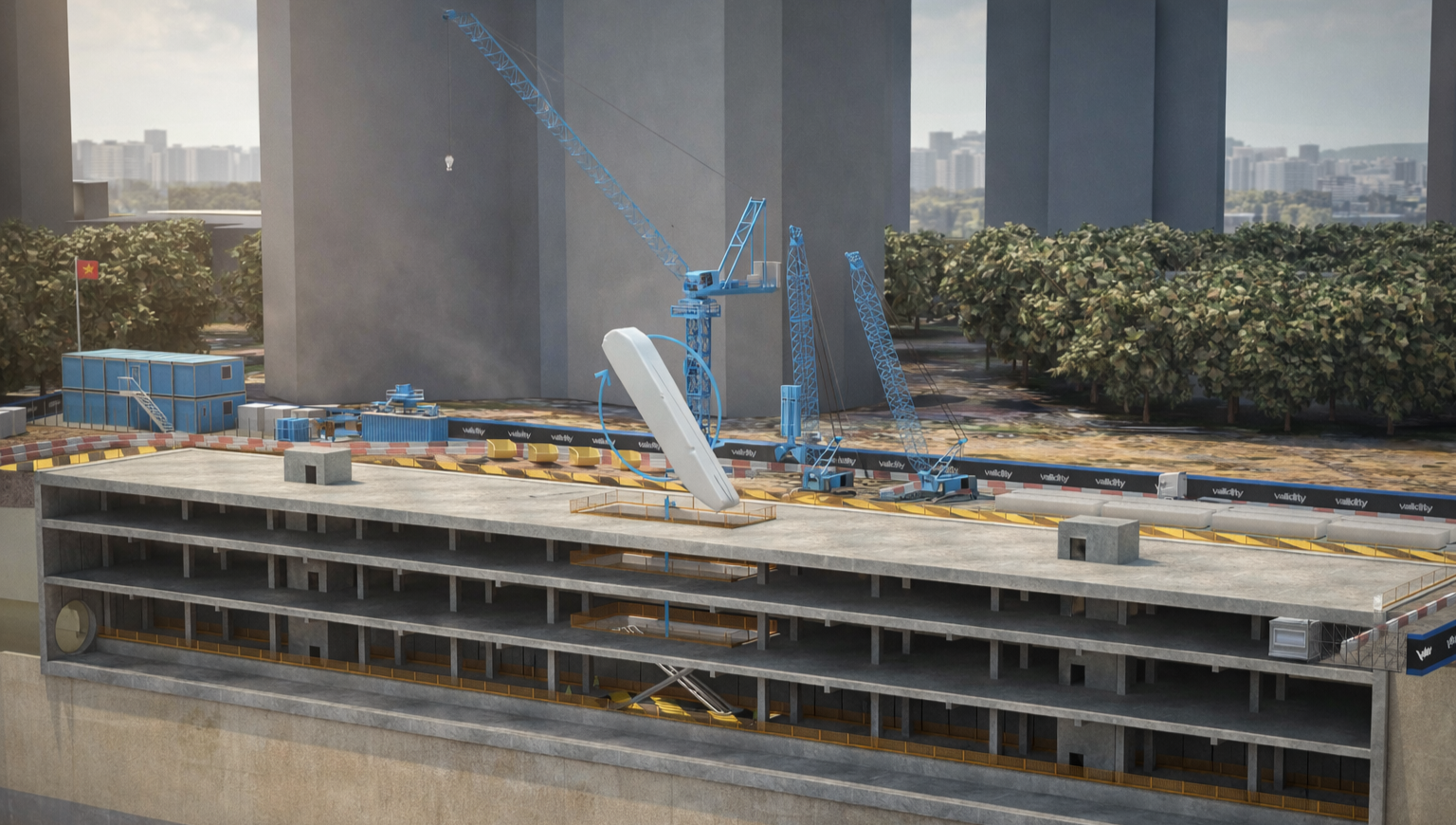
What about the other terms?
Each of the other terms has a legitimate home, but they describe specific things rather than the discipline as a whole.
"4D Simulation" is the closest to 4D Planning in everyday use, and it is not wrong. But simulation implies a higher degree of fidelity and behavioural modelling than most 4D workflows involve. Simulation, in engineering, typically means replicating a real-world system with enough accuracy to predict outcomes. Most 4D work is communicative rather than predictive at that level. It shows what is planned, not what will dynamically emerge. The term is better reserved for more advanced computational workflows.
"Construction Sequencing" describes one specific output of 4D Planning: the order in which elements are built. It is a valid term for a deliverable but too narrow to describe the broader discipline. A sequencing diagram can be produced without any 3D model at all. The two are not equivalent.
"Digital Rehearsal" is our favourite of the aspirational terms. It captures something important: the idea that you are practising the build before it happens, identifying clashes, testing logic, and stress-testing assumptions in a safe digital environment before steel is ordered or concrete is poured. We use this term when we want to communicate value to a non-technical audience, because it immediately frames the work as risk reduction and preparation rather than technology for its own sake. It is a communication tool more than a technical descriptor.
"Virtual Construction" is the American cousin of 4D Planning, used heavily in the US market. It carries broadly the same meaning but also encompasses wider constructability analysis and clash detection, so it is a broader term than we would usually need.
"Schedule Visualisation" and "Phasing and Logistics Visualisation" are accurate but undersell the discipline. They describe what appears on screen rather than the thinking behind it. A programme linked to a model and exported as a video is not just a visualisation. It is a planning tool, a coordination mechanism, and a project management document.
"Model-Based Scheduling" is a term gaining traction in some circles, particularly in infrastructure. It suggests that the schedule and the model are developed together rather than retrofitted to one another, which is a more sophisticated approach to 4D work. We like the principle, though the term has not yet entered common usage.
"Time-Location Planning" or "Time-Chainage" refers to a specific technique used predominantly in linear infrastructure, tunnelling, and highways work. It plots activity against distance along a route rather than against time alone. It is a 4D Planning technique for a specific project type, not an alternative name for the discipline.
Why terminology matters
You might wonder why any of this matters. Labels, after all, are just labels.
We think they matter for two reasons.
First, precision builds trust. When you describe your work accurately, clients and collaborators know what they are getting. When you use inflated or imprecise terms, it creates expectations the work cannot always meet. "4D BIM" implies a level of integrated data management that a time-based visualisation alone does not deliver. Getting found online via the right search terms, and then delivering exactly what those terms promised, is how a reputation is built.
Second, the discipline of 4D Planning deserves its own identity. It is not a subset of BIM. It is not just simulation. It is a planning discipline in its own right, one that requires expertise in construction methodology, programme logic, model management, and communication. Giving it a clear, consistent name helps establish it as that.
At Validity Global, we specialise in 4D Planning and construction sequencing. We work across sectors including commercial, residential, healthcare, and infrastructure, helping teams plan, communicate, and deliver complex construction projects more effectively. Whatever you want to call it when you search for us, we are glad you found this post. But when you work with us, you will hear us call it 4D Planning.
Because that is what it is.
Want to talk about your project? Whether you are scoping a programme for tender, preparing a logistics strategy for planning approval, or looking to introduce 4D into your project workflow for the first time, get in touch.